
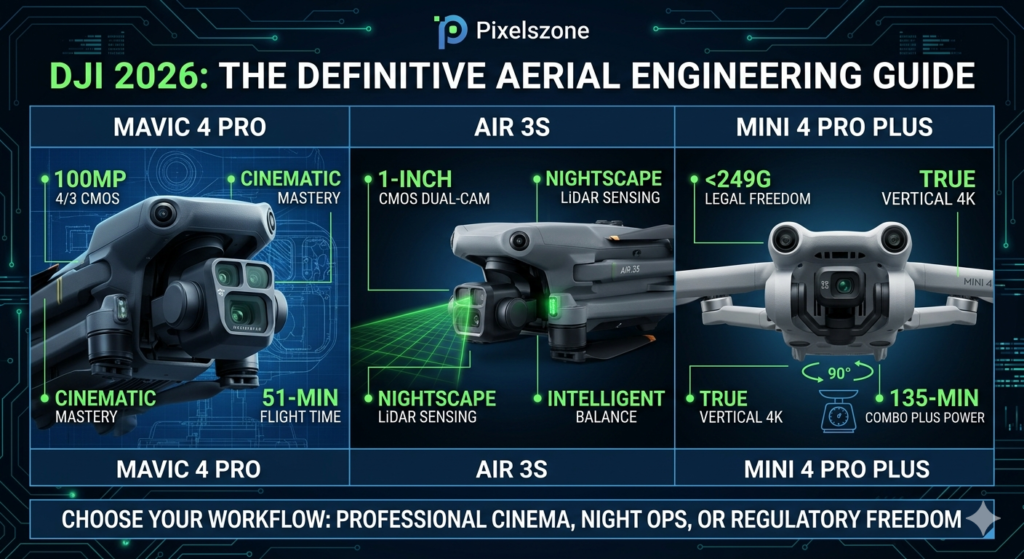
In the world of informatics and networking, we don’t just see a drone as a flying camera; we see it as a “flying data processing system.” In 2026, DJI has set new standards where your choice depends on “System Architecture” and “Image Throughput.” At Pixelszone, we analyzed the three latest giants to reveal which one earns a spot in your gear bag.
1. DJI Mavic 4 Pro: The Cinematic Flagship
For those seeking “Visual Perfection,” the Mavic 4 Pro is a mobile workstation that pushes the boundaries of possibility.
- Technical Depth (The 100MP Beast): Featuring a 4/3 CMOS Hasselblad sensor, this drone doesn’t just take photos; it captures 100 million pixels of raw data. This allows for massive digital cropping without losing crispness.
- Transmission Protocol (O4+ System): Engineered with a 30km range, the O4+ system ensures signal stability even in urban environments crowded with wireless interference.
- Endurance: With a 51-minute flight time, it offers the engineering freedom to reshoot until you reach perfection.

- 100MP Main Camera – DJI Mavic 4 Pro’s 100MP Hasselblad camera with 6K/60fps HDR video captures stunning drone footage wi…
- Versatile Tele Images – Dual tele cameras on this drone deliver crisp, detailed zooms for professional aerial photograph…
- Dynamic Angles Unleashed – The camera drone’s 360° Infinity Gimbal [4] offers dynamic camera movement for cinematic shot…
2. DJI Air 3S: The Night Engineer (LiDAR Evolution)
The Air 3S represents the perfect balance between size and power, a favorite for those seeking “AI-driven” flight.
- The LiDAR Revolution: The standout feature is the integrated Forward LiDAR. Technically, this means the drone “sees” obstacles using lasers in pitch darkness, providing safety levels traditional vision sensors can’t match.
- Dual Lens Strategy: With both Wide and Medium Tele cameras, you can change your visual storytelling language with a single tap, eliminating the need to physically move the drone.
- Dynamic Range: The 1-inch sensor provides 14 stops of dynamic range, making it the king of sunset and night cityscapes.

- Enhanced Camera for Travel Shots – Air 3S’s 1″ CMOS primary camera delivers breathtaking shots with enriched detail in l…
- Capture Footage with Vibrant Detail – Record cinematic 4K/60fps HDR video with up to 14 stops of dynamic range [4] to se…
- Free Panorama Mode – Create seamless panoramic shots by stitching together images. Wide-angle panos offer a wider scope …
3. DJI Mini 4 Pro Plus: The Smart Travel Companion
DJI Mini 4 Pro Plus: The genius engineering solution to “Regulatory Constraints.”
- Sub-249g Engineering: Designed to stay under the legal weight limit for registration in most countries, yet it houses the heart of a “Pro.”
- The “Plus” Advantage: This version breaks time barriers with batteries delivering 45 minutes of flight—an incredible feat for such a compact frame.
- True Vertical Shooting: The gimbal physically rotates 90 degrees, capturing native 4K HDR vertical video without losing a single pixel to software cropping.

- 𝗨𝗻𝗱𝗲𝗿 𝟮𝟰𝟵 𝗴, 𝗡𝗼 𝗥𝗲𝗴𝗶𝘀𝘁𝗿𝗮𝘁𝗶𝗼𝗻 𝗜𝘀 𝗥𝗲𝗾𝘂𝗶𝗿𝗲𝗱[1] – Travel light and skip registration for a user-friendly, easy-to-carry expe…
- For the latest aircraft firmware, 𝘁𝗵𝗲 𝗥𝗲𝗺𝗼𝘁𝗲 𝗜𝗗 𝘄𝗶𝗹𝗹 𝗼𝗻𝗹𝘆 𝗯𝗲 𝗮𝗰𝘁𝗶𝘃𝗮𝘁𝗲𝗱 𝘄𝗵𝗲𝗻 𝘁𝗵𝗲 𝗜𝗻𝘁𝗲𝗹𝗹𝗶𝗴𝗲𝗻𝘁 𝗙𝗹𝗶𝗴𝗵𝘁 𝗕𝗮𝘁𝘁𝗲𝗿𝘆 𝗣𝗹𝘂𝘀 𝗶𝘀 𝘂𝘀𝗲𝗱….
- 𝗨𝗻𝗹𝗲𝗮𝘀𝗵 𝗦𝘁𝘂𝗻𝗻𝗶𝗻𝗴 𝗩𝗲𝗿𝘁𝗶𝗰𝗮𝗹 𝗩𝗶𝗱𝗲𝗼𝘀 𝗶𝗻 𝟰𝗞/𝟲𝟬𝗳𝗽𝘀 𝗛𝗗𝗥 – Perfectly showcases sunrise, sunset, and night scenes with impressive…
Conclusion: Which Giant Deserves Your Investment?
To wrap up this technical analysis, it’s clear that DJI has designed each drone to solve specific workflow challenges. As specialists, we believe the best choice isn’t necessarily the most expensive, but rather the most efficient for your specific projects.
- If your goal is large-scale printing and cinematic production that refuses to compromise on detail, the Mavic 4 Pro is your dream flying studio.
- If you thrive on night-time challenges and urban storytelling with peak safety, the LiDAR technology in the Air 3S is your ultimate partner.
- If you are a travel-focused creator seeking “regulatory freedom” without sacrificing pro-grade quality, the Mini 4 Pro Plus is the engineering miracle that fits in your pocket.
The Technical Matrix: Comprehensive Comparison
| Feature | DJI Mavic 4 Pro (Flagship) | DJI Air 3S (Balanced) | DJI Mini 4 Pro Plus (Travel) |
| Main Sensor | 100MP (4/3 CMOS) | 50MP (1-inch) | 48MP (1/1.3-inch) |
| Camera System | Triple Camera | Dual Camera | Single Camera |
| Obstacle Sensing | 360° Omnidirectional | Night LiDAR + Vision | 360° Omnidirectional |
| Max Flight Time | 51 Minutes | 45 Minutes | 45 Minutes (with Plus Battery) |
| Transmission Range | 30 km (O4+) | 20 km (O4) | 20 km (O4) |
| Weight | ~950g | ~720g | Sub-249g |
| Vertical Shooting | Software Processing | Software Processing | True Native (90° Rotation) |
| Target Audience | Cinema Directors & Pros | Real Estate & Night Ops | Travelers & Social Creators |
Join the Conversation: Which of these technologies (100MP, LiDAR, or True Vertical) do you believe will have the biggest impact on your upcoming content? Let us know in the comments!